How to Build a Full-Funnel Digital Marketing Strategy That Converts?

A company can have excellent traffic and still have a terrible marketing system.
That sounds contradictory until the numbers are separated. Thousands of people may visit a website, watch a video, download a guide or follow a social account without ever becoming customers. The problem is rarely a complete absence of interest. More often, the business has built one part of the customer journey and neglected the rest.
A strong full-funnel digital marketing strategy treats marketing less like a collection of campaigns and more like a connected customer journey from first discovery to repeat purchase and advocacy.
The distinction matters because people do not normally move from stranger to customer in one click.
The Funnel is Really a Sequence of Decisions
The traditional funnel is often drawn as a neat triangle: awareness at the top, consideration in the middle, conversion at the bottom.
Real customers are messier.
Someone may discover a company through a Google search, leave, encounter its social content a week later, read three reviews, return through an email and finally call the sales team. Another prospect may watch a video first, visit a competitor's website, search for comparisons and come back months later.
The funnel still works as a planning model. It simply should not be mistaken for a literal map of human behavior.
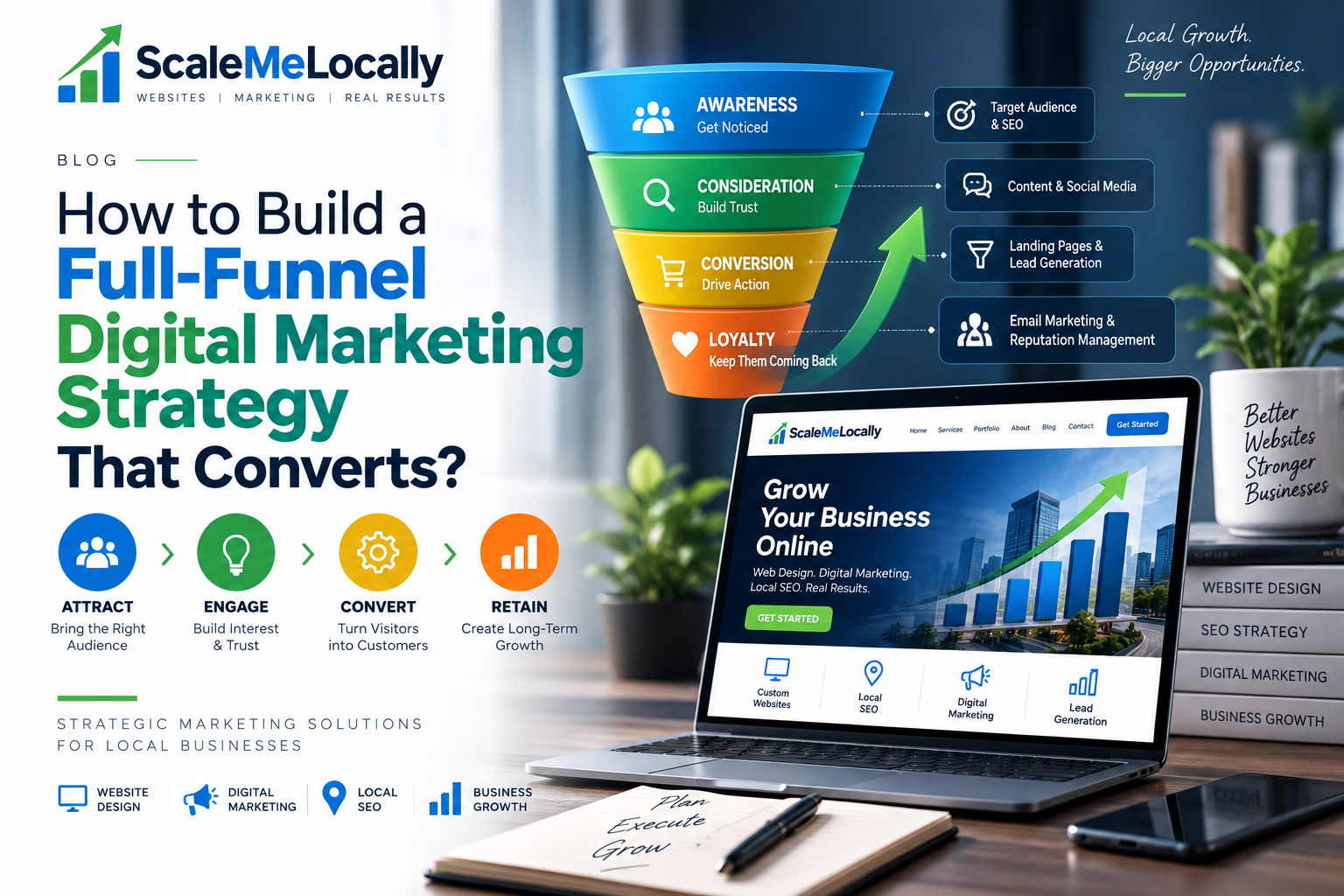
A useful four-stage framework is:
● Awareness: the prospect discovers the business.
● Consideration: the prospect investigates whether the business is credible and relevant.
● Conversion: the prospect takes the desired commercial action.
● Loyalty: the customer stays, buys again, refers others or becomes an advocate.
The objective is not to force every person through those stages in exactly that order. It is to make sure the business has something useful waiting at each stage.
That is where many marketing programs break down.
Start with the Customer
The easiest way to create a weak funnel is to begin with a list of platforms.
“Let's run Instagram.”
“Let's add Google Ads.”
“Let's send a newsletter.”
Those are channel decisions. They are not strategy.
A better starting point is the customer's problem.
What causes someone to look for the product? What information do they need before trusting the company? What makes them hesitate? What finally removes the friction around the purchase?
Only after those questions are understood should the business decide which types of digital marketing services belong in the mix.
For one company, SEO and educational content may create the first meaningful interaction. Another may depend heavily on paid search because customers already know what they need. A B2B organization with a six-month sales cycle might rely on webinars, case studies, email nurturing and sales enablement.
Same funnel. Different machinery.
1. Stage One: Awareness is About Being Discovered for a Reason
The top of the funnel is often treated as a numbers game.
More impressions. More followers. More traffic.
That can become expensive noise.
Awareness works better when the content answers a question the audience already has or introduces a problem the audience recognizes. Search-optimized articles, educational videos, social content, podcasts, digital PR and paid social campaigns can all contribute here.
SEO is particularly useful when the audience is actively looking for information. Social content can be stronger when the business needs to create familiarity before a search occurs.
Paid advertising has another advantage: speed.
A company can put a message in front of a carefully defined audience almost immediately and learn from the response. Organic visibility tends to compound more slowly.
The mistake is judging awareness campaigns entirely by immediate sales.
A person who encounters a brand for the first time may not be ready to buy. The job at this stage is often simpler: earn enough attention to make the next interaction possible.
2. Stage Two: Consideration Is Where Trust Gets Built
This is the part of the funnel that receives surprisingly little attention.
A prospect has arrived. They are interested. Then they start asking harder questions.
Can this company solve the problem? Is the product worth the price? Are there better alternatives? Has anyone else used it successfully?
This is where case studies, comparison pages, testimonials, product demonstrations, webinars, guides, email sequences and retargeting become useful.
A retargeting advertisement might remind a previous visitor about a service. An email sequence can answer objections that prevented an immediate purchase. A detailed case study can demonstrate competence without resorting to broad claims about being “the best.”
That last point is easy to overlook.
Trust is rarely created by repeating the company's strengths. It is created by giving the prospect enough evidence to reach the conclusion independently.
A good consideration-stage asset behaves more like a well-made museum exhibit than a sales pitch: it gives visitors enough context to understand what they are looking at, then lets the evidence do some of the work.
3. Stage Three: Conversion Should Remove Friction, Not Manufacture Pressure
By the time a prospect reaches the conversion stage, the business should not need to explain everything again.
The landing page should answer the remaining practical questions.
What happens next? How much does it cost? What does the customer receive? How quickly can the process begin? Is there a guarantee, trial or clear cancellation policy?
The call to action should be obvious.
Not clever. Obvious.
For ecommerce, conversion optimization may involve product-page improvements, simplified checkout, stronger product information, reviews and abandoned-cart sequences. For lead generation, the priority may be a shorter form, clearer service information, stronger proof and a more useful consultation offer.
This is also where digital marketing becomes tightly connected to the website itself.
A brilliant ad cannot rescue a confusing landing page indefinitely.
The Uncomfortable Truth About Conversion Rates
A common assumption is that better marketing means sending more qualified traffic into the funnel.
Sometimes it does.
Sometimes the better move is to stop sending traffic altogether and fix what happens after the click.
That contradiction matters. A business spending heavily on acquisition may be trying to solve a conversion problem with more acquisition.
If 10,000 visitors produce 100 customers, doubling traffic is one option. Improving the journey so that those same 10,000 visitors produce 150 customers is another, and the economics can be dramatically different.
This is why landing-page testing, offer positioning, pricing presentation and sales follow-up deserve a place inside a serious funnel strategy.
4. Stage Four: The Sale Is Not the End of the Funnel
Marketing teams often celebrate the conversion and move immediately to acquisition.
That leaves money on the table.
The post-purchase stage can include onboarding emails, customer education, loyalty programs, review requests, cross-sell campaigns, renewal reminders and referral programs. The exact mix depends on the business model, but the principle is consistent: the relationship changes after purchase; it does not disappear.
Retention deserves attention for another reason. Research summarized by Harvard Business Review has found that retaining customers can be substantially less expensive than acquiring new ones, with the economic value varying considerably by industry and business model.
For subscription businesses, retention can determine whether acquisition spending is profitable at all.
For ecommerce, repeat purchases can change customer lifetime value.
For professional services, one successful engagement may become a multi-year relationship.
The funnel should account for that.
A Full Funnel Needs One Measurement System
Here is where many otherwise sophisticated campaigns become difficult to manage.
The awareness team reports impressions. The content team reports page views. Paid media reports clicks and conversions. Sales reports closed deals. Customer success reports retention.
Everyone has numbers.
Nobody has the same story.
A useful measurement framework connects activity to business outcomes.
At the awareness level, marketers might monitor reach, impressions, qualified traffic and cost per thousand impressions. In consideration, engagement quality, lead volume, content consumption and assisted conversions become more informative. At the conversion stage, customer acquisition cost, conversion rate, revenue and return on ad spend matter more. After purchase, retention, repeat purchase rate, churn and customer lifetime value become increasingly important.
The exact metrics should follow the business model.
There is no universal dashboard.
How to Measure Digital Marketing Success Without Worshipping Attribution
Last-click attribution is tempting because it is easy to understand.
The customer clicked an advertisement and purchased. Give the advertisement credit.
Except the customer may have encountered the company four times before that click.
Google's current analytics documentation explicitly recognizes this problem. Customers can interact with multiple ads and channels before completing a key event, which is why attribution models exist in the first place. Google Analytics currently supports data-driven attribution and last-click approaches for paid and organic channel reporting; older models such as linear, time-decay and position-based attribution were removed in 2023.
For businesses asking how to measure digital marketing success, the practical answer is to connect marketing measurement to actual business events: purchases, qualified leads, booked appointments, calls, subscriptions or other outcomes that matter commercially.
Google Ads' conversion measurement framework similarly allows advertisers to define valuable actions such as purchases, sign-ups and phone calls and evaluate campaigns against those actions.
Attribution is useful.
It is not an oracle.
Budgeting Should Follow the Economics
The common advice to allocate 20% to awareness, 30% to consideration, 40% to conversion and 10% to loyalty sounds precise.
It is also too neat.
A new consumer brand may need substantial awareness investment because nobody knows it exists. A mature B2B company with strong organic demand may need relatively little awareness spending and considerably more investment in conversion and retention.
The right allocation depends on:
● Customer acquisition cost
● Average order value
● Sales-cycle length
● Existing brand awareness
● Repeat purchase behavior
● Available organic demand
● Competitive pressure
● Gross margin
● Customer lifetime value
A funnel budget should behave like a portfolio, not a pie chart carved into permanent percentages.
Money moves toward the bottleneck.
How Should Different Digital Marketing Channels Work Together?
The types of digital marketing services are most effective when each has a defined role.
SEO can capture existing demand.
Content can educate and establish expertise.
Paid search can capture high-intent prospects.
Social media can create familiarity and conversation.
Email can nurture known prospects and customers.
Retargeting can reconnect with people who have already shown interest.
Conversion-rate optimization can improve what happens after traffic arrives.
Analytics provides the feedback loop.
None of these channels needs to “win.”
Their job is to make the next stage more likely.
This is also where the debate around digital marketing vs traditional marketing becomes relevant. A television advertisement, billboard or direct-mail campaign may create awareness that later appears as branded search traffic. A digital campaign may then capture that demand. Treating the channels as isolated systems can make the original source of demand almost impossible to see.
How Long Should a Funnel Take to Work?
There is no honest universal timeline.
Paid search can produce clicks and conversions within days. A new SEO program generally requires considerably more patience because visibility depends on content quality, competition, site authority and search behavior. Conversion-rate improvements can sometimes appear quickly after a major usability problem is corrected; other tests require enough traffic and time to produce a meaningful result.
The important distinction is between activity and evidence.
A campaign being live does not mean it has generated enough evidence to justify a major strategic conclusion.
A business that changes its funnel every seven days is not necessarily optimizing. It may simply be reacting.
Good marketers allow enough time for a hypothesis to be tested, then change the part of the system that the evidence implicates.
The Funnel Should Eventually Become a Feedback Loop
A mature full-funnel digital marketing strategy does not remain a straight line.
Customer data from the bottom of the funnel informs the top.
If sales teams discover that the highest-value customers consistently mention one particular problem, that insight can shape SEO topics, social content and advertising creative. If retention falls after a specific onboarding step, the post-purchase experience becomes the next optimization target. If certain acquisition channels generate many leads but few qualified opportunities, the problem may be targeting rather than sales performance.
That is the real sophistication of full-funnel marketing.
Not more channels.
Better connections between them.
The strongest systems gradually become self-correcting: customer behavior creates information, information changes the marketing, and the revised marketing produces better customer behavior.
What a Converting Funnel Ultimately Looks Like
There is no perfect funnel template.
There is a business with a defined audience, a clear commercial objective and a customer journey that has been studied closely enough to reveal where people lose interest, lose confidence or simply get confused.
From there, the strategy becomes practical.
Create awareness that earns attention. Build consideration with useful evidence. Remove friction at conversion. Develop the relationship after purchase. Measure outcomes rather than vanity metrics. Then return to the weakest point and improve it.
That is the difference between “doing digital marketing” and building a marketing system.
Traffic is only the beginning.
Conversion is the test.A company can have excellent traffic and still have a terrible marketing system.
That sounds contradictory until the numbers are separated. Thousands of people may visit a website, watch a video, download a guide or follow a social account without ever becoming customers. The problem is rarely a complete absence of interest. More often, the business has built one part of the customer journey and neglected the rest.
A strong full-funnel digital marketing strategy treats marketing less like a collection of campaigns and more like a connected customer journey from first discovery to repeat purchase and advocacy.
The distinction matters because people do not normally move from stranger to customer in one click.
The Funnel is Really a Sequence of Decisions
The traditional funnel is often drawn as a neat triangle: awareness at the top, consideration in the middle, conversion at the bottom.
Real customers are messier.
Someone may discover a company through a Google search, leave, encounter its social content a week later, read three reviews, return through an email and finally call the sales team. Another prospect may watch a video first, visit a competitor's website, search for comparisons and come back months later.
The funnel still works as a planning model. It simply should not be mistaken for a literal map of human behavior.
A useful four-stage framework is:
● Awareness: the prospect discovers the business.
● Consideration: the prospect investigates whether the business is credible and relevant.
● Conversion: the prospect takes the desired commercial action.
● Loyalty: the customer stays, buys again, refers others or becomes an advocate.
The objective is not to force every person through those stages in exactly that order. It is to make sure the business has something useful waiting at each stage.
That is where many marketing programs break down.
Start with the Customer
The easiest way to create a weak funnel is to begin with a list of platforms.
“Let's run Instagram.”
“Let's add Google Ads.”
“Let's send a newsletter.”
Those are channel decisions. They are not strategy.
A better starting point is the customer's problem.
What causes someone to look for the product? What information do they need before trusting the company? What makes them hesitate? What finally removes the friction around the purchase?
Only after those questions are understood should the business decide which types of digital marketing services belong in the mix.
For one company, SEO and educational content may create the first meaningful interaction. Another may depend heavily on paid search because customers already know what they need. A B2B organization with a six-month sales cycle might rely on webinars, case studies, email nurturing and sales enablement.
Same funnel. Different machinery.
1. Stage One: Awareness is About Being Discovered for a Reason
The top of the funnel is often treated as a numbers game.
More impressions. More followers. More traffic.
That can become expensive noise.
Awareness works better when the content answers a question the audience already has or introduces a problem the audience recognizes. Search-optimized articles, educational videos, social content, podcasts, digital PR and paid social campaigns can all contribute here.
SEO is particularly useful when the audience is actively looking for information. Social content can be stronger when the business needs to create familiarity before a search occurs.
Paid advertising has another advantage: speed.
A company can put a message in front of a carefully defined audience almost immediately and learn from the response. Organic visibility tends to compound more slowly.
The mistake is judging awareness campaigns entirely by immediate sales.
A person who encounters a brand for the first time may not be ready to buy. The job at this stage is often simpler: earn enough attention to make the next interaction possible.
2. Stage Two: Consideration Is Where Trust Gets Built
This is the part of the funnel that receives surprisingly little attention.
A prospect has arrived. They are interested. Then they start asking harder questions.
Can this company solve the problem? Is the product worth the price? Are there better alternatives? Has anyone else used it successfully?
This is where case studies, comparison pages, testimonials, product demonstrations, webinars, guides, email sequences and retargeting become useful.
A retargeting advertisement might remind a previous visitor about a service. An email sequence can answer objections that prevented an immediate purchase. A detailed case study can demonstrate competence without resorting to broad claims about being “the best.”
That last point is easy to overlook.
Trust is rarely created by repeating the company's strengths. It is created by giving the prospect enough evidence to reach the conclusion independently.
A good consideration-stage asset behaves more like a well-made museum exhibit than a sales pitch: it gives visitors enough context to understand what they are looking at, then lets the evidence do some of the work.
3. Stage Three: Conversion Should Remove Friction, Not Manufacture Pressure
By the time a prospect reaches the conversion stage, the business should not need to explain everything again.
The landing page should answer the remaining practical questions.
What happens next? How much does it cost? What does the customer receive? How quickly can the process begin? Is there a guarantee, trial or clear cancellation policy?
The call to action should be obvious.
Not clever. Obvious.
For ecommerce, conversion optimization may involve product-page improvements, simplified checkout, stronger product information, reviews and abandoned-cart sequences. For lead generation, the priority may be a shorter form, clearer service information, stronger proof and a more useful consultation offer.
This is also where digital marketing becomes tightly connected to the website itself.
A brilliant ad cannot rescue a confusing landing page indefinitely.
The Uncomfortable Truth About Conversion Rates
A common assumption is that better marketing means sending more qualified traffic into the funnel.
Sometimes it does.
Sometimes the better move is to stop sending traffic altogether and fix what happens after the click.
That contradiction matters. A business spending heavily on acquisition may be trying to solve a conversion problem with more acquisition.
If 10,000 visitors produce 100 customers, doubling traffic is one option. Improving the journey so that those same 10,000 visitors produce 150 customers is another, and the economics can be dramatically different.
This is why landing-page testing, offer positioning, pricing presentation and sales follow-up deserve a place inside a serious funnel strategy.
4. Stage Four: The Sale Is Not the End of the Funnel
Marketing teams often celebrate the conversion and move immediately to acquisition.
That leaves money on the table.
The post-purchase stage can include onboarding emails, customer education, loyalty programs, review requests, cross-sell campaigns, renewal reminders and referral programs. The exact mix depends on the business model, but the principle is consistent: the relationship changes after purchase; it does not disappear.
Retention deserves attention for another reason. Research summarized by Harvard Business Review has found that retaining customers can be substantially less expensive than acquiring new ones, with the economic value varying considerably by industry and business model.
For subscription businesses, retention can determine whether acquisition spending is profitable at all.
For ecommerce, repeat purchases can change customer lifetime value.
For professional services, one successful engagement may become a multi-year relationship.
The funnel should account for that.
A Full Funnel Needs One Measurement System
Here is where many otherwise sophisticated campaigns become difficult to manage.
The awareness team reports impressions. The content team reports page views. Paid media reports clicks and conversions. Sales reports closed deals. Customer success reports retention.
Everyone has numbers.
Nobody has the same story.
A useful measurement framework connects activity to business outcomes.
At the awareness level, marketers might monitor reach, impressions, qualified traffic and cost per thousand impressions. In consideration, engagement quality, lead volume, content consumption and assisted conversions become more informative. At the conversion stage, customer acquisition cost, conversion rate, revenue and return on ad spend matter more. After purchase, retention, repeat purchase rate, churn and customer lifetime value become increasingly important.
The exact metrics should follow the business model.
There is no universal dashboard.
How to Measure Digital Marketing Success Without Worshipping Attribution
Last-click attribution is tempting because it is easy to understand.
The customer clicked an advertisement and purchased. Give the advertisement credit.
Except the customer may have encountered the company four times before that click.
Google's current analytics documentation explicitly recognizes this problem. Customers can interact with multiple ads and channels before completing a key event, which is why attribution models exist in the first place. Google Analytics currently supports data-driven attribution and last-click approaches for paid and organic channel reporting; older models such as linear, time-decay and position-based attribution were removed in 2023.
For businesses asking how to measure digital marketing success, the practical answer is to connect marketing measurement to actual business events: purchases, qualified leads, booked appointments, calls, subscriptions or other outcomes that matter commercially.
Google Ads' conversion measurement framework similarly allows advertisers to define valuable actions such as purchases, sign-ups and phone calls and evaluate campaigns against those actions.
Attribution is useful.
It is not an oracle.
Budgeting Should Follow the Economics
The common advice to allocate 20% to awareness, 30% to consideration, 40% to conversion and 10% to loyalty sounds precise.
It is also too neat.
A new consumer brand may need substantial awareness investment because nobody knows it exists. A mature B2B company with strong organic demand may need relatively little awareness spending and considerably more investment in conversion and retention.
The right allocation depends on:
● Customer acquisition cost
● Average order value
● Sales-cycle length
● Existing brand awareness
● Repeat purchase behavior
● Available organic demand
● Competitive pressure
● Gross margin
● Customer lifetime value
A funnel budget should behave like a portfolio, not a pie chart carved into permanent percentages.
Money moves toward the bottleneck.
How Should Different Digital Marketing Channels Work Together?
The types of digital marketing services are most effective when each has a defined role.
SEO can capture existing demand.
Content can educate and establish expertise.
Paid search can capture high-intent prospects.
Social media can create familiarity and conversation.
Email can nurture known prospects and customers.
Retargeting can reconnect with people who have already shown interest.
Conversion-rate optimization can improve what happens after traffic arrives.
Analytics provides the feedback loop.
None of these channels needs to “win.”
Their job is to make the next stage more likely.
This is also where the debate around digital marketing vs traditional marketing becomes relevant. A television advertisement, billboard or direct-mail campaign may create awareness that later appears as branded search traffic. A digital campaign may then capture that demand. Treating the channels as isolated systems can make the original source of demand almost impossible to see.
How Long Should a Funnel Take to Work?
There is no honest universal timeline.
Paid search can produce clicks and conversions within days. A new SEO program generally requires considerably more patience because visibility depends on content quality, competition, site authority and search behavior. Conversion-rate improvements can sometimes appear quickly after a major usability problem is corrected; other tests require enough traffic and time to produce a meaningful result.
The important distinction is between activity and evidence.
A campaign being live does not mean it has generated enough evidence to justify a major strategic conclusion.
A business that changes its funnel every seven days is not necessarily optimizing. It may simply be reacting.
Good marketers allow enough time for a hypothesis to be tested, then change the part of the system that the evidence implicates.
The Funnel Should Eventually Become a Feedback Loop
A mature full-funnel digital marketing strategy does not remain a straight line.
Customer data from the bottom of the funnel informs the top.
If sales teams discover that the highest-value customers consistently mention one particular problem, that insight can shape SEO topics, social content and advertising creative. If retention falls after a specific onboarding step, the post-purchase experience becomes the next optimization target. If certain acquisition channels generate many leads but few qualified opportunities, the problem may be targeting rather than sales performance.
That is the real sophistication of full-funnel marketing.
Not more channels.
Better connections between them.
The strongest systems gradually become self-correcting: customer behavior creates information, information changes the marketing, and the revised marketing produces better customer behavior.
What a Converting Funnel Ultimately Looks Like
There is no perfect funnel template.
There is a business with a defined audience, a clear commercial objective and a customer journey that has been studied closely enough to reveal where people lose interest, lose confidence or simply get confused.
From there, the strategy becomes practical.
Create awareness that earns attention. Build consideration with useful evidence. Remove friction at conversion. Develop the relationship after purchase. Measure outcomes rather than vanity metrics. Then return to the weakest point and improve it.
That is the difference between “doing digital marketing” and building a marketing system.
Traffic is only the beginning.
Conversion is the test.