Copywriting vs Content Writing: What’s the Real Difference?

If you’ve ever hired a “writer” for your business and gotten results that felt… off, this is probably why. Writing is not writing. A blog post and a sales page might both be made of sentences, but they’re built to do completely different jobs.
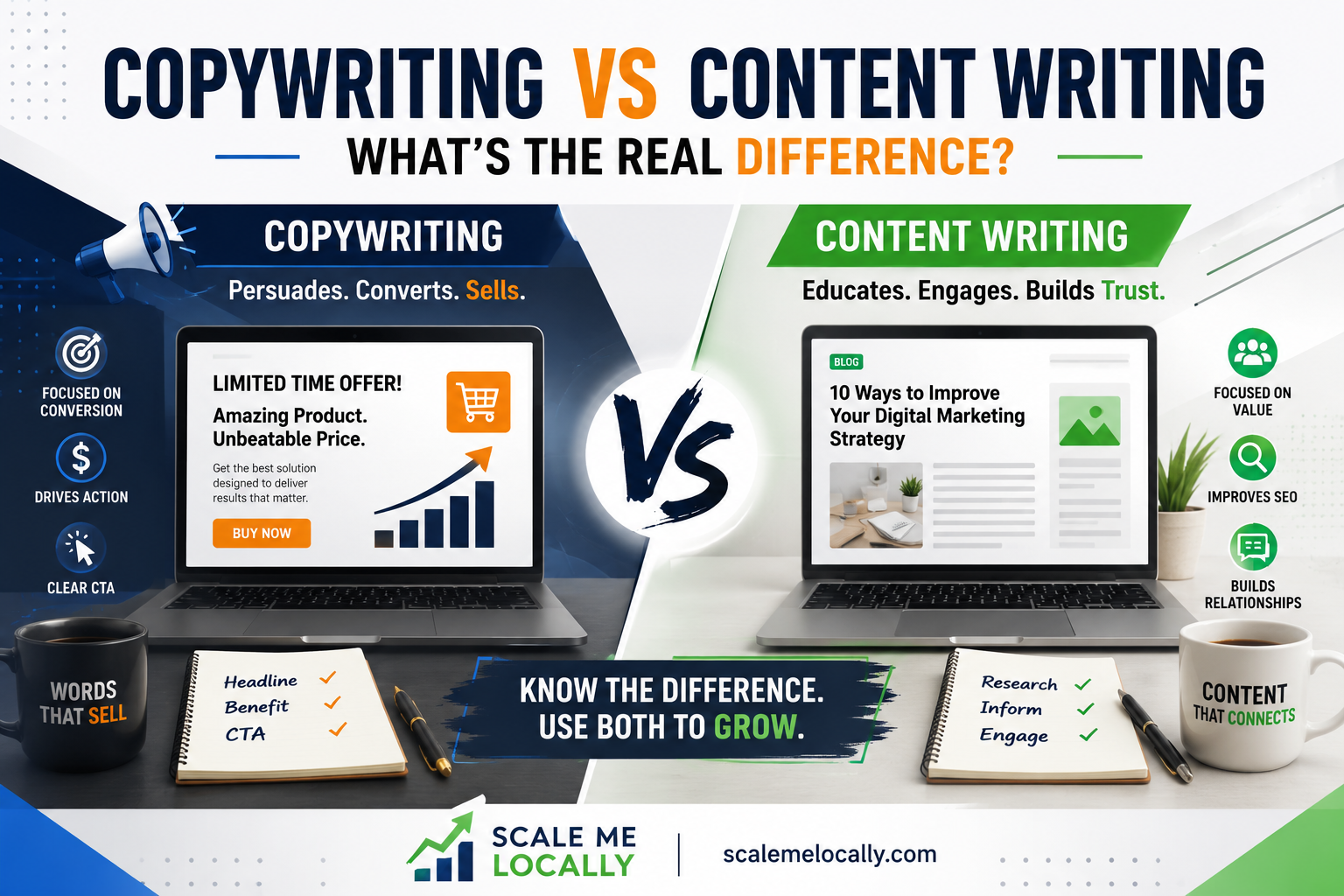
Here’s the short answer: content writing informs, copywriting sells. Content writing builds trust over time through blogs, guides, and newsletters. Copywriting pushes for an immediate action: a click, a signup, a purchase through ads, landing pages, and emails.
That one-line answer is true. It’s also not enough to actually run a marketing strategy on. So let’s get into the copywriting vs content writing difference in a way that actually changes how you brief your next writer.
What Is Content Writing, Exactly?
Content writing is the stuff that teaches, entertains, or answers a question. Its job is to make someone smarter or more informed by the time they finish reading, not to close a sale on the spot.
Think:
● Blog posts
● Newsletters
● eBooks and guides
● White papers
● Video scripts for educational content
The goal is trust and visibility. A good piece of content writing ranks on Google, gets shared, and quietly positions your brand as the one that actually knows what it’s talking about. The call to action is usually soft: “subscribe,” “read more,” “check out this related guide.”
I write a lot of this kind of content myself, and the tell that it’s working isn’t clicks. It’s when someone emails three weeks after reading a piece and says “I’ve been following your blog for a while” before they’ve ever bought anything.
What Is Copywriting, Exactly?
Copywriting exists to make something happen right now. It’s persuasive by design, built around a single action you want the reader to take before they close the tab.
Think:
● Landing pages
● Sales emails
● PPC and social ads
● Product pages
● Billboards and taglines
Copywriting is short on purpose. Nobody reads a billboard for five minutes. Even a “long” sales page is really just one argument, repeated and reinforced from different angles, aimed at one decision.
I once rewrote a client’s landing page headline from “Innovative Solutions for Modern Businesses” to “Cut Your Invoice Time From 3 Days to 20 Minutes.” Same product, same page, same traffic. Conversions went from 1.8% to 4.3% in the following month. Nothing else changed. That’s the entire power of copywriting in one example: specificity beats cleverness, and clarity beats cleverness even harder.
The Actual Differences, Side by Side
1. The Psychology Behind Each One
Content writing educates. It’s the storyteller walking someone from “I don’t understand this” to “okay, I get it now.” Copywriting provokes a decision. It’s the persuader, aimed at the gap between “I get it” and “I’m doing it.”
2. How They Treat SEO
Content writing leans hard on keywords, search intent, and long-tail phrases because organic traffic is often its entire reason for existing. Copywriting benefits from SEO but won’t sacrifice clarity for it; nobody stuffs keywords into a headline that has three seconds to earn a click.
3. Length
Content writing is often long-form, 1,500 to 3,000+ words because depth is part of what earns trust and ranking. Copywriting is usually short and punchy. A headline might be five words. A strong ad might be under 40.
4. The Call to Action
Content writing uses soft CTAs: “read more,” “subscribe,” “learn how this works.” Copywriting uses hard CTAs: “buy now,” “book a call,” “get 50% off before Friday.”
| Factor | Content Writing | Copywriting |
| Primary goal | Trust, authority, SEO | Conversion, sales |
| Typical length | Long-form (1,500+ words) | Short, scannable |
| Tone | Informative, storyteller | Persuasive, urgent |
| CTA style | Soft (“subscribe”) | Hard (“buy now”) |
| Example formats | Blogs, guides, newsletters | Landing pages, ads, sales emails |
Offense vs. Defense: A Way to Actually Remember This
I use a sports analogy with clients because it sticks better than any dictionary definition.
Content writing is defense. It warms up cold traffic. It answers objections before they’re spoken, and it makes a stranger feel safe enough to stick around. A good blog post doesn’t try to score; it keeps the ball on your side of the field and builds a lead worth keeping.
Copywriting is offense. It’s what happens once the reader is already warm. It takes that trust and converts it into an email address, a demo booking, a sale. Offense without defense is a team that’s always chasing a lead they never built. Defense without offense is a team that never actually wins the game.
Most businesses I’ve audited have one or the other, not both. That’s usually the actual reason their marketing “isn’t working,” not the writing quality, but the missing half.
Why You Need Both, Not One or the Other
This isn’t really a “which is better” question, even though it gets framed that way constantly. Content and copy aren’t competitors. They’re stages of the same funnel.
● Content writing brings a stranger to your blog and earns their attention (top of funnel).
● Copywriting takes that warmed-up reader and turns them into a lead or customer on a landing page or in a follow-up email (bottom of funnel).
If content is the fuel, copywriting is the engine. Fuel with no engine just sits there. An engine with no fuel doesn’t move at all.
A rough rule I’ve found useful across client accounts: aim for roughly 80% content, 20% direct copy in your overall output. Most of what you publish should be genuinely useful, not salesy. The smaller slice landing pages, key emails, product pages is where you switch fully into persuasion mode.
How to Decide What You’re Actually Writing
Before you write anything, ask what the reader is doing right now.
● Researching or learning? → Write content. They’re not ready to buy, and a hard pitch will just push them away.
● Comparing options or ready to act? → Write copy. They already know the problem; they need a reason to choose you, now.
This single question solves most of the “should this sound salesy or helpful?” debates that happen inside marketing teams.
A Mistake Worth Admitting
Early on, I handed a SaaS client’s onboarding email sequence, which needed to convert trial users into paying customers, to a writer who was brilliant at blog content and nothing else. The emails read beautifully. They were also completely useless at getting anyone to upgrade, because they informed instead of persuaded. We lost most of that trial cohort. Lesson learned the expensive way: matching the wrong skill set to the wrong stage of the funnel doesn’t just underperform; it can actively cost you customers who were already halfway to buying.If you’ve ever hired a “writer” for your business and gotten results that felt… off, this is probably why. Writing is not writing. A blog post and a sales page might both be made of sentences, but they’re built to do completely different jobs.
Here’s the short answer: content writing informs, copywriting sells. Content writing builds trust over time through blogs, guides, and newsletters. Copywriting pushes for an immediate action: a click, a signup, a purchase through ads, landing pages, and emails.
That one-line answer is true. It’s also not enough to actually run a marketing strategy on. So let’s get into the copywriting vs content writing difference in a way that actually changes how you brief your next writer.
What Is Content Writing, Exactly?
Content writing is the stuff that teaches, entertains, or answers a question. Its job is to make someone smarter or more informed by the time they finish reading, not to close a sale on the spot.
Think:
● Blog posts
● Newsletters
● eBooks and guides
● White papers
● Video scripts for educational content
The goal is trust and visibility. A good piece of content writing ranks on Google, gets shared, and quietly positions your brand as the one that actually knows what it’s talking about. The call to action is usually soft: “subscribe,” “read more,” “check out this related guide.”
I write a lot of this kind of content myself, and the tell that it’s working isn’t clicks. It’s when someone emails three weeks after reading a piece and says “I’ve been following your blog for a while” before they’ve ever bought anything.
What Is Copywriting, Exactly?
Copywriting exists to make something happen right now. It’s persuasive by design, built around a single action you want the reader to take before they close the tab.
Think:
● Landing pages
● Sales emails
● PPC and social ads
● Product pages
● Billboards and taglines
Copywriting is short on purpose. Nobody reads a billboard for five minutes. Even a “long” sales page is really just one argument, repeated and reinforced from different angles, aimed at one decision.
I once rewrote a client’s landing page headline from “Innovative Solutions for Modern Businesses” to “Cut Your Invoice Time From 3 Days to 20 Minutes.” Same product, same page, same traffic. Conversions went from 1.8% to 4.3% in the following month. Nothing else changed. That’s the entire power of copywriting in one example: specificity beats cleverness, and clarity beats cleverness even harder.
The Actual Differences, Side by Side
1. The Psychology Behind Each One
Content writing educates. It’s the storyteller walking someone from “I don’t understand this” to “okay, I get it now.” Copywriting provokes a decision. It’s the persuader, aimed at the gap between “I get it” and “I’m doing it.”
2. How They Treat SEO
Content writing leans hard on keywords, search intent, and long-tail phrases because organic traffic is often its entire reason for existing. Copywriting benefits from SEO but won’t sacrifice clarity for it; nobody stuffs keywords into a headline that has three seconds to earn a click.
3. Length
Content writing is often long-form, 1,500 to 3,000+ words because depth is part of what earns trust and ranking. Copywriting is usually short and punchy. A headline might be five words. A strong ad might be under 40.
4. The Call to Action
Content writing uses soft CTAs: “read more,” “subscribe,” “learn how this works.” Copywriting uses hard CTAs: “buy now,” “book a call,” “get 50% off before Friday.”
Factor Content Writing Copywriting
Primary goal Trust, authority, SEO Conversion, sales
Typical length Long-form (1,500+ words) Short, scannable
Tone Informative, storyteller Persuasive, urgent
CTA style Soft (“subscribe”) Hard (“buy now”)
Example formats Blogs, guides, newsletters Landing pages, ads, sales emails
Offense vs. Defense: A Way to Actually Remember This
I use a sports analogy with clients because it sticks better than any dictionary definition.
Content writing is defense. It warms up cold traffic. It answers objections before they’re spoken, and it makes a stranger feel safe enough to stick around. A good blog post doesn’t try to score; it keeps the ball on your side of the field and builds a lead worth keeping.
Copywriting is offense. It’s what happens once the reader is already warm. It takes that trust and converts it into an email address, a demo booking, a sale. Offense without defense is a team that’s always chasing a lead they never built. Defense without offense is a team that never actually wins the game.
Most businesses I’ve audited have one or the other, not both. That’s usually the actual reason their marketing “isn’t working,” not the writing quality, but the missing half.
Why You Need Both, Not One or the Other
This isn’t really a “which is better” question, even though it gets framed that way constantly. Content and copy aren’t competitors. They’re stages of the same funnel.
● Content writing brings a stranger to your blog and earns their attention (top of funnel).
● Copywriting takes that warmed-up reader and turns them into a lead or customer on a landing page or in a follow-up email (bottom of funnel).
If content is the fuel, copywriting is the engine. Fuel with no engine just sits there. An engine with no fuel doesn’t move at all.
A rough rule I’ve found useful across client accounts: aim for roughly 80% content, 20% direct copy in your overall output. Most of what you publish should be genuinely useful, not salesy. The smaller slice landing pages, key emails, product pages is where you switch fully into persuasion mode.
How to Decide What You’re Actually Writing
Before you write anything, ask what the reader is doing right now.
● Researching or learning? → Write content. They’re not ready to buy, and a hard pitch will just push them away.
● Comparing options or ready to act? → Write copy. They already know the problem; they need a reason to choose you, now.
This single question solves most of the “should this sound salesy or helpful?” debates that happen inside marketing teams.
A Mistake Worth Admitting
Early on, I handed a SaaS client’s onboarding email sequence, which needed to convert trial users into paying customers, to a writer who was brilliant at blog content and nothing else. The emails read beautifully. They were also completely useless at getting anyone to upgrade, because they informed instead of persuaded. We lost most of that trial cohort. Lesson learned the expensive way: matching the wrong skill set to the wrong stage of the funnel doesn’t just underperform; it can actively cost you customers who were already halfway to buying.